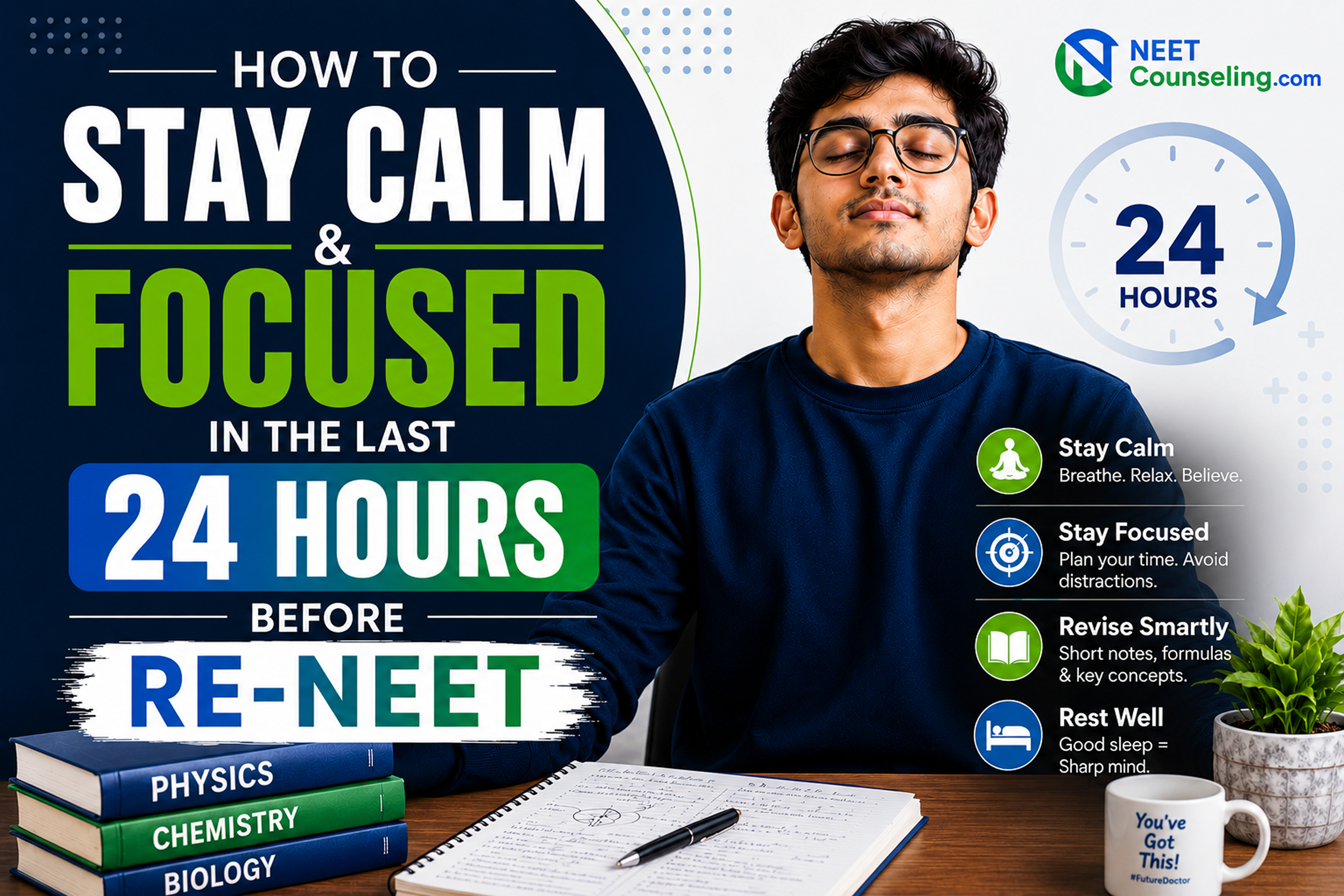
The last 24 hours before giving any test or examination could be quite stressful, particularly for NEET candidates appearing for re-NEET. After months of study, mock tests, revisions, and lost sleep, the last day is full of emotions – excitement, fear, doubt, anticipation, and so much more. Most candidates have doubts about how much they have studied, whether they will remember it all in the examination hall, and whether they will be able to give their best.
But the fact of the matter is that the last 24 hours for re-NEET should not be spent studying new concepts or covering the complete syllabus. Rather, this is the time that should be used for staying clear-headed, managing stress, retaining confidence, and making sure that your body and mind are ready to give their best in the examination hall.
Stress in the final hours is entirely common. But too much stress might make it difficult to recall memories, make decisions, focus, and build confidence. Therefore, stress management becomes as important as preparation.
This guide contains some practical and evidence-based ways of coping with stress in the last 24 hours of re-NEET.
Students tend to overlook the importance of the last day prior to taking an exam. Though most academic preparations have been done, the state of mind and body of the student at this particular time can greatly affect his or her performance.
A student who is mentally and physically sound is much more likely to perform better than a student who has been studying for the entire night.
The last 24 hours can have an impact on:
Consider the last day as the last part of the marathon. Instead of running fast, you should conserve your energy and finish the race in good condition.
In order to manage stress, it is essential to first understand what provokes it.
The common reasons why most NEET aspirants feel stressed include the following:
Most students are afraid that they might not have enough knowledge. They have doubts like "What if I forget something important?" or "What if I make some mistakes?"
Family expectations, societal pressure, and personal goals may put additional pressure.
The comparison between yourself and friends, coaching batchmates, or even social media debates may lead to undue stress.
Even the most prepared candidates feel anxious regarding the level of difficulty, question pattern, and the level of competition in the paper.
It is essential to recognize such triggers, which will allow students to cope with them in a rational manner instead of giving rise to anxieties.
The last day must be spent on consolidation and not on acquiring new knowledge.
Instead of opening up new chapters, revise what you have already studied.
Consolidation is the key rather than intensive preparation.
One mistake many students make is that they start looking for "most expected questions" or "last-minute prediction papers."
Rely on the sources that have been helping you all along your preparation process.
The last day needs to be planned out wisely.
Start your day with an optimistic attitude.
Do not begin your preparations by immediately turning to your books.
Instead, engage in some stretches, light exercises, or walking.
It aids in lowering cortisol levels and improving concentration.
Do not try anything hard or new at this point.
The afternoon should be devoted to revising.
Now is not the time to do mock tests since poor results will lower your confidence level.
The evening should be devoted to unwinding mentally.
Students feel guilty about stopping their studies,s but it is actually better for their performance.
One of the best ways of managing stress is through positive self-talk.
The brain reacts greatly to one's inner conversations.
The trouble is that many learners use the last minutes for contemplations like:
Such thoughts lead to even greater anxiety.
|
Negative Thought |
Positive Replacement |
|
I am not ready |
I have prepared consistently |
|
I will forget everything |
My revision will help me recall information |
|
Others are better than me |
I am focusing on my own performance |
|
I might fail |
I will give my best effort |
Positive thinking does not imply being oblivious to the hurdles. Positive thinking implies approaching challenges confidently and not with fear.
These last 24 hours are no time to be wasting too much time on social media.
Most students tend to unknowingly create more stress for themselves through the following sources:
These pieces of information do not contribute anything.
|
Avoid |
Prefer |
|
Exam rumors |
Official notifications |
|
Comparison posts |
Personal revision |
|
Negative discussions |
Relaxation activities |
|
Endless scrolling |
Limited screen time |
Reducing digital distractions helps students maintain mental clarity and emotional stability.
One of the fastest methods of reducing anxiety is practicing deep breathing exercises.
In case the student is anxious, his/her breathing pattern changes; it becomes shallow and fast. The brain perceives such a breathing pattern as a signal of danger, thus causing anxiety.
Deep breathing exercises reverse this process.
The student can practice this exercise before going to sleep, when travelling to the exam center, or before entering the examination hall.
Many aspirants are tempted to take one final mock test.
It is normally not recommended within 24 hours before the main test.
Don’t test your abilities, but try to build up confidence.
If you want to revise, try to solve some easy questions from previous tests.
A surprising amount of stress comes from last-minute logistical issues.
Preparing examination materials beforehand eliminates unnecessary anxiety.
|
Essential Item |
Status Check |
|
Admit Card |
✓ |
|
Valid ID Proof |
✓ |
|
Passport-size Photograph |
✓ |
|
Transparent Water Bottle (if allowed) |
✓ |
|
Required Stationery |
✓ |
|
Exam Center Details |
✓ |
|
Travel Plan |
✓ |
Preparing these items one day earlier provides peace of mind.
The most common mistake made by students before taking NEET is neglecting sleep.
They feel that studying through the night will help them gain an edge.
However, lack of sleep negatively affects:
|
Aspect |
Benefit |
|
Memory |
Better retention and recall |
|
Focus |
Improved concentration |
|
Mood |
Reduced irritability |
|
Performance |
Faster thinking and accuracy |
Get at least 7–8 hours of good-quality sleep before the exam.
Because it’s easier to recall facts when your brain is well-rested.
The last few hours usually include discussions and phone calls.
Although this can be useful, discussions that are related to your studies will only increase your level of stress.
Talking about complex Physics questions or controversial concepts in Biology will make you doubt yourself.
Confidence is better than hurried revision during panic attacks.
Visualization is a psychological technique used by athletes, performers, and successful people.
Imagine yourself:
Exam day starts well before one arrives at the test venue.
Ensure you wake up at a sufficient hour to avoid being rushed.
Have a healthy breakfast and never skip any meal.
Most students make use of every second to memorize information.
This often leads to higher anxiety.
Rather:
Stress associated with travel can affect performance before taking the exam.
To prevent this:
Should the level of anxiety increase, breathe deeply during the travel.
These last few seconds before entering the exam hall are always very stressful for most students.
The people surrounding you might be discussing tough issues, comparing their levels of preparation, and predicting question trends.
Do not participate in all of these activities.
Just do the following instead:
Do note that no learning takes place in the last few minutes.
Even if you are very calm, you can get stressed after looking at the question paper.
This is completely natural.
Do not forget that difficult questions will be there for everyone, not just you.
Many students try their best to prepare a perfect paper.
Such expectations increase stress.
No one can answer all questions perfectly.
NEET requires:
Forget about perfection, focus on performance.
The final 24 hours are not a time to evaluate your preparation.
Think of:
Your preparation has already paved the path to success.
The last 24 hours before re-NEET can be highly stressful for you; however, it is a time during which you can make the most of your performance via proper stress management techniques. Your aim during this period is not to absorb hundreds of new things but to remain confident and emotionally balanced.
You should revise more than just cramming. You need to have sleep more than studying at midnight. Eat healthy food, drink plenty of water, take deep breaths, and avoid comparing yourself with others. Prepare all the items that you may need in the examination and go to it with full self-confidence.
Thousands of hours of preparation cannot be replaced in one day, but can definitely be supplemented with it. The students who show the best performance are not those who prepare for long hours in the last day before the exam, but those who go to the examination hall confidently.
Approaching the time of the re-NEET examination, do not forget that you have already prepared a lot. It is just the time to protect your mental energy and stay positive.

.png)
.jpeg)


 100% secure payments · Encrypted checkout